

HybridFilament: Development of a Cost-Effective Manufacturing Process for Wire–Polymer Composites in Fused Filament Fabrication (FFF) Using Hybrid Filaments
Duration: 01.01.2026 – 31.12.2027
Description
For the additive manufacturing of conductive traces and functional structures such as sensors, coils, etc., processes such as laser direct structuring (LDS) or dispensing techniques can be employed. However, these methods are difficult to access due to high material costs, significant manufacturing effort, limited quality (in the case of dispensing), and the requirement for specialized equipment. In comparison, FFF (fused filament fabrication) 3D printers offer a cost-effective and widely available alternative. By using conductive filaments, they enable the economical production of functional structures. In such filaments, electrical conductivity is achieved through dispersed particles that form stochastic contact networks. However, currently available filaments exhibit low conductivity (11,500 Ω·mm²/m; compared to copper: 0.0167 Ω·mm²/m [1]), relatively high material costs, and poor processing quality. To provide a viable alternative, the electrical conductivity must be increased significantly. The HyFi (hybrid filaments) project aims to address this challenge. Within this research project, a filament containing a solid metal wire core is to be developed, which is suitable for use in FFF processes. This approach enables the application of conductive tracks with solid copper conductors (0.0167 Ω·mm²/m) using the cost-efficient means of FFF technology and existing equipment. It has already been demonstrated that a filament consisting of a wire core and a polymer sheath is suitable for processing in standard printing systems [2]. To enable industrial application, the filament extrusion processes will be analyzed to ensure the required quality and functionality. Within the project, a nozzle system for filament production lines will be developed, allowing precise feeding and centering of the core material. In addition, processing parameters (e.g., temperature, speed) will be investigated to enable optimal use of the filament across different 3D printing systems. The research focuses on enabling comprehensive applications using standardized electronic components and will investigate various contacting solutions to allow, for example, seamless integration of plug connectors. These findings will be consolidated into a complementary process guideline to facilitate the accessible implementation of printed electronics for a wide range of German SMEs. In the long term, the process is expected to be applicable both for single-part manufacturing and for the production of small-scale series.
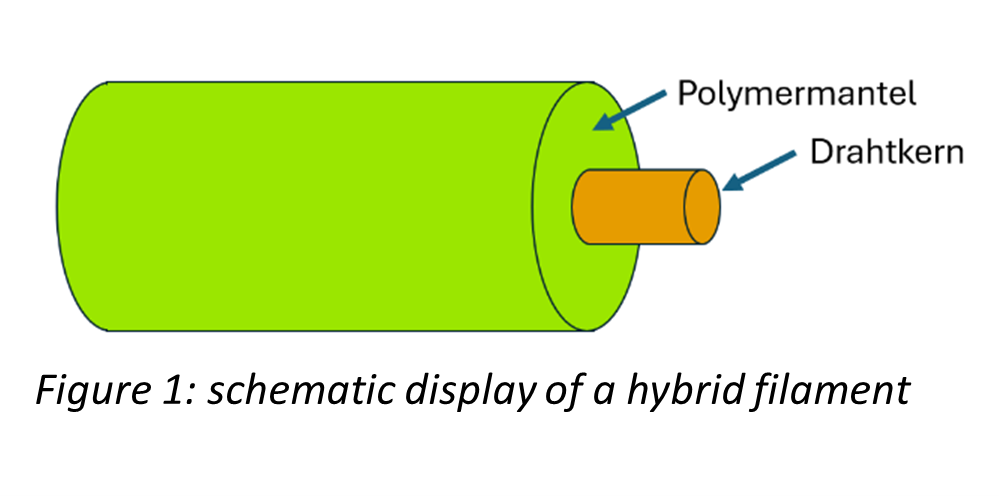
Research objective
Development of a technology for the cost-efficient manufacturing of functional composite materials (up to 30 times less expensive compared to silver conductive paste) using the FFF process with a hybrid filament that enables the production of wire–polymer composite structures on existing printing systems.
To meet the requirements of signal transmission and power transmission, filaments with different core wire diameters will be produced using the materials PLA, ABS, TPU, and PC.
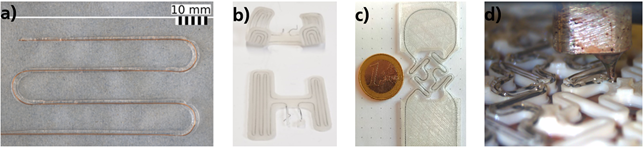
Figure 2: Preliminary work on hybrid filaments: (a) Cu wire ⌀ 0.2 mm with TPU filament on 100 µm TPU film; (b) finger orthosis with integrated heating elements ⌀ 0.2 mm; (c) mesostructure with heating wires ⌀ 0.2 mm; (d) deposition of the hybrid filament during the printing process.
Benefits and Economic Relevance for SMEs
The global market size for printed electronics was estimated at USD 11.74 billion in 2023 and is expected to grow at an annual rate of 22.4%, increasing from USD 13.80 billion in 2024 to USD 69.54 billion by 2032 [8]. The market size for 3D printing filaments is projected to grow from USD 0.91 billion in 2024 to USD 2.21 billion in 2029, corresponding to an annual growth rate of 19.48% [9]. In addition to the overall growth of the technology field, the FFF process remains the most widely used additive manufacturing method and is available in-house to 71% of users [10]. Due to its cost efficiency, this process is particularly relevant for SMEs [11]. The manufacturing of electrical functionalities is of broad industrial relevance, and the proposed project enables cost-efficient implementation across a wide range of industries. Consequently, many SMEs gain access to process automation capabilities that would otherwise predominantly take place outside Europe. Immediately following the project, filament manufacturers will be able to introduce validated, innovative filaments to the market and thereby achieve a first-mover advantage. Printer users within the project consortium expand the capabilities of their existing equipment and can offer optimized solutions. Due to the open-material system, new material combinations can be evaluated and optimized with low entry barriers. This enables potential specializations in sensing applications, heating elements, or reinforcement fibers. As a result, the field of application is not limited to conductive tracks but can be flexibly extended and adapted to specific demands.
Research institutes and contact persons
For further contact details, please contact the office. E-Mail to office
- Fraunhofer-Institut für Werkzeugmaschinen und Umformtechnik IWU
